Official DE OpenBlackHole BH 1.4
image including patches, DTS Surround, DVB-T Automatic, CrossEPG, Cron, WebInterface
working and Inadyn, DynDNS plugins preinstalled.
Our Support Forum : www.japhar.com


Description of Features of DE OpenBlackHole BH 1.4
- Auto DVB-T
- DTS Surround
- CrossEPG Plugin (0.6.2 svn 305)
- DynDNS Plugin
- Inadyn Plugin
- Cron
- BlackHole GUI
a) Showing InfoBar CAS infos
b) BluePanel
c) AutoCam
d) Extra Settings Menu e) Cron Manager
f) Osd Settings (set Picons to LCD)
g) Devices Manager
h) Kernel Modules Manager
i) Fast Plugin Settings]
j) GreenPanel
k) Script Manager
l) System Setup : Show Event-progress in channel selection
...
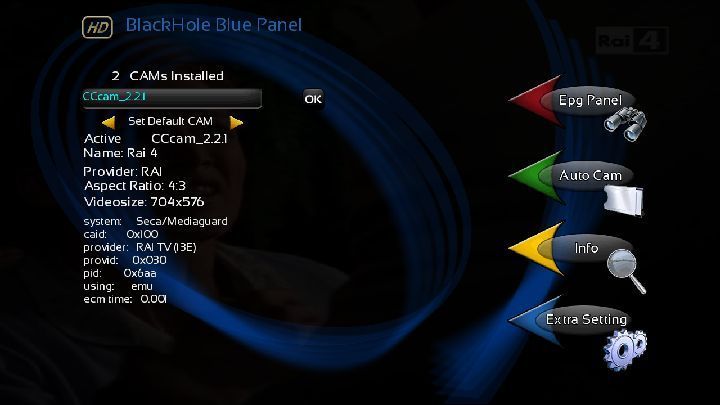
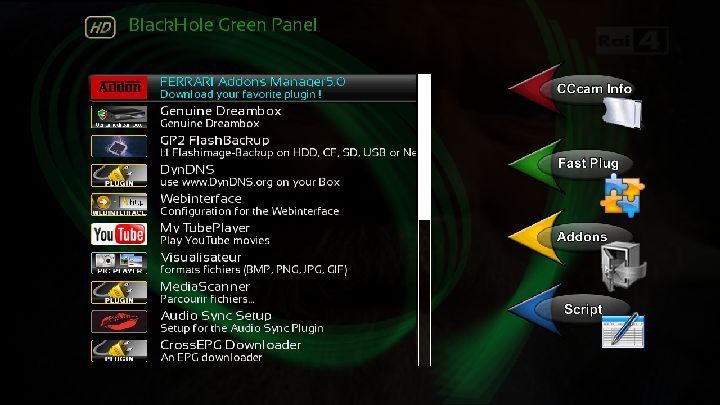
P.S.: After installation and regularly, install the latest patch available on the Addon Manager Panel to have latest functionnalitites active and fully working.
DM800se (Japhar Sim) : Download here
or From datafilehost.com or from MEGA
DM800se (Ferrari) : Download here
or From datafilehost.com or from MEGA
DM800se (Sim2 box) : Download here
or From datafilehost.com or from MEGA
DM800se (eStar Sim) : Download here
or From datafilehost.com or from MEGA
DM800se (Original box) : Download here
or From datafilehost.com or from MEGA
DM500HD (Japhar Sim) : Download here
or From datafilehost.com or from MEGA
DM500HD (Ferrari) : Download here
or From datafilehost.com or from MEGA
DM500HD (Sim2 box) : Download here
or From datafilehost.com or from MEGA
DM500HD (Original box) : Download here
or From datafilehost.com or from MEGA
DM8000 (Japhar Sim) : Download here
or From datafilehost.com or from MEGA
DM8000 (Ferrari) : Download here
or From datafilehost.com or from MEGA
DM8000 (Original box) : Download here
or From datafilehost.com or from MEGA
DM800 (Japhar Sim) : Download here
or From datafilehost.com or from MEGA
DM800 (Ferrari) : Download here
or From datafilehost.com or from MEGA
DM800 (Sim2 box) : Download here
or From datafilehost.com or from MEGA
DM800 (Original box) : Download here
or From datafilehost.com or from MEGA
DM800 (Release Praline Sim 1.0 SSL70) : Download here
or From datafilehost.com or from MEGA
DM800 (Release Praline Sim 1.0 SSL69) : Download here
or From datafilehost.com or from MEGA
DM7025/+ Mips (SSL83) : Download here
or From datafilehost.com or from MEGA
VU+ Solo (Ferrari v2) : Download here
or From datafilehost.com or from MEGA
VU+ Solo (Ferrari Kernel v3.1.1) : Download here
or From datafilehost.com or from MEGA
VU+ Solo (Ferrari Image v3.2) : Download here
or From datafilehost.com or from MEGA
VU+ Solo2 (Ferrari) : Download here
or From datafilehost.com or from MEGA
VU+ Uno (Ferrari) : Download here
or From datafilehost.com or from MEGA
VU+ Duo (Ferrari) : Download here
or From datafilehost.com or from MEGA
Debrideur Rapidgator May 2026
If you search for "Debrideur Rapidgator gratuit" (free), you will find hundreds of sketchy websites. Proceed with extreme caution.
Golden Rule: If a Debrideur for Rapidgator is free and requires no captcha, you are the product—not the customer.
Following the decline of early peer-to-peer (P2P) networks and the shutdown of pioneering cyberlockers like Megaupload in 2012, the landscape of digital file sharing shifted significantly. The new dominant paradigm became the "cyberlocker"—a centralized server hosting files for download—and the "DDL" (Direct Download) scene. Among the myriad of hosts that emerged, Rapidgator established itself as a prominent entity due to its high retention rates and affiliate payout structures.
However, the proliferation of different file hosts created a fragmentation problem for end-users. To download files from various sources without restriction, users were forced to purchase multiple premium subscriptions. This economic friction birthed the "debrideur" (debrid service), a technical intermediary designed to bypass these restrictions. This paper analyzes the technical function of debrid services in relation to hosts like Rapidgator and evaluates their impact on the digital content economy.
Deepbrid is one of the few remaining free debrideurs. It requires no registration for basic use.
For the user, the complexity of the ecosystem is flattened. Instead of managing accounts for Rapidgator, Nitroflare, and 1fichier, they interact solely with the debrid interface. This effectively creates a "Super-Premium" account.
Les debrideurs Rapidgator peuvent offrir commodité et vitesses améliorées, mais comportent des risques juridiques, de sécurité et de confidentialité. Priorisez des sources légales et des services fiables, et appliquez des précautions de sécurité si vous choisissez d’en utiliser un.
(Options connexes que vous pourriez vouloir : comparatif de services debrideurs populaires, guide pas‑à‑pas d’utilisation sécurisée, ou alternatives légales — dites laquelle vous intéresse.)
Title: The Ecosystem of Cyberlockers and Debrid Services: A Technical and Economic Analysis of Rapidgator and Multi-Hosters
Abstract
This paper explores the operational mechanics and socio-economic role of "debrideur" (debrid) services within the cyberlocker ecosystem, with a specific focus on the host Rapidgator. As the "premium" model of file hosting became the dominant monetization strategy in the post-Megaupload era, third-party services known as multi-hosters or debrids emerged to aggregate premium accounts. This analysis examines the symbiotic yet contentious relationship between file hosts and debrid services, the technical implementation of link conversion, and the legal ambiguities surrounding these tools. The study concludes that debrid services represent a market response to the fragmented premium subscription model, functioning as a "grey market" aggregator that fundamentally alters the accessibility of copyrighted content.
In the sprawling ecosystem of file hosting and peer-to-peer sharing, services like Rapidgator have become dominant players, offering storage and distribution for vast amounts of data. However, their business model—often characterized by slow free download speeds, intrusive advertising, and enforced waiting periods—has given rise to a parallel universe of third-party tools designed to subvert these limitations. Among the most notorious of these tools are “debriders” or “debrid services.” The term “Debrideur Rapidgator” refers specifically to software or online services that aim to “debride” (remove the restrictions of) the Rapidgator platform. Acting as a digital scalpel, this tool dissects and neutralizes the host’s paywalls and throttling mechanisms. While offering undeniable utility to the end-user, the Debrideur occupies a legally ambiguous, ethically fraught, and technically precarious position within the modern digital economy.
Function and Mechanism: How the Debrideur Operates
At its core, a Debrideur Rapidgator functions as an intermediary or a proxy with premium credentials. The user does not download a file directly from Rapidgator’s free servers. Instead, they submit the Rapidgator link to the debrid service. The service, which maintains its own paid premium Rapidgator account, fetches the file at maximum speed and without waiting. The debrid server then relays that file to the user, effectively laundering a free download through a premium pipe.
This process bypasses three key restrictions: the download speed cap (often limiting free users to 50-100 KB/s), the cooldown timer between downloads (which can last from 30 minutes to several hours), and parallel download limits. Advanced debriders may also offer features like link generation for download managers, automatic extraction of archives, and integration with other hosts (Uploaded, Nitroflare, etc.). In essence, the Debrideur does not hack Rapidgator’s servers; rather, it exploits the legitimate premium access model by sharing a single account among thousands of users, violating the host’s terms of service.
The User’s Perspective: Convenience vs. Cost
From the viewpoint of the average internet user—especially those in regions where paid subscriptions are expensive relative to local income, or those who only infrequently download large files—the Debrideur is a rational economic tool. A lifetime subscription to a debrid service (e.g., Real-Debrid, AllDebrid, or a custom script) often costs less than a single month of a dedicated Rapidgator premium account. This aggregation model is financially attractive.
Moreover, debriders solve a practical problem: the fragmentation of content. A user seeking a specific Linux distribution, a public domain film, or a modded game file may find it hosted on Rapidgator, but also on FileFactory, 1Fichier, or Mega. Maintaining individual premium accounts for each host is prohibitively expensive. A single debrid service that supports fifty hosts thus becomes a unified key, unlocking all doors. This convenience is the primary driver of their popularity, not malice toward Rapidgator specifically.
Legal and Ethical Quandaries: The Parasite-Host Relationship
The legal status of Debrideur Rapidgator is a murky battleground. Rapidgator’s Terms of Service explicitly forbid account sharing, reselling access, or using automated scripts to download files. Therefore, using a debrid service constitutes a breach of contract. However, the legal consequences typically fall on the debrid service operator, not the end-user, who is merely a beneficiary of the breach. In jurisdictions like France (home to many debrid services) or Germany (where Rapidgator has legal presence), courts have issued mixed rulings. Some have ordered debrid services to block access to specific hosts, while others have recognized the service as a legitimate “proxy tool” when no copyrighted material is involved.
The ethical dimension is more nuanced. Content creators and file hosts argue that debriders are digital parasites. Rapidgator invests in servers, bandwidth, and security. Its free tier is deliberately limited to encourage paid upgrades, which fund the platform’s existence. By circumventing these limits, debriders deny the host revenue while consuming its resources. This is not piracy of content per se, but piracy of access. If a user downloads a legally distributed freeware file via a debrid service, the content owner loses nothing, but Rapidgator loses a potential customer and pays for the bandwidth nonetheless. The argument is akin to using someone else’s metro pass: the train runs regardless, but the operator is defrauded.
Security and Technical Risks: The Price of a Shortcut
For the end-user, the hidden cost of using a Debrideur Rapidgator is often security. To use most debrid services, the user must either install a browser extension, a desktop application, or—in the case of script-based debriders—run arbitrary code from GitHub or obscure forums. This presents a significant attack surface. Malicious actors have been known to distribute “cracked” debrid tools that function as trojans, logging the user’s own premium credentials or installing cryptocurrency miners.
Even legitimate debrid services present a privacy risk. The service operator can see every link a user submits, building a detailed profile of their downloading habits. While many services claim to delete logs, few are audited. Furthermore, because the debrid server downloads the file first, the user has no guarantee that the file hasn’t been intercepted or modified. A user downloading a software ISO via a debrid service might receive a version injected with malware—an attack vector that is less likely when downloading directly from the host’s own encrypted connection.
The Cat-and-Mouse Game: Mitigation and Evolution
Rapidgator is not passive in this struggle. Over the years, it has implemented countermeasures against debriders. These include detecting and banning IP addresses associated with known debrid servers, implementing CAPTCHA challenges that automated scripts struggle to solve, and introducing “premium-only” files that even the free tier cannot access. In response, debrid services have rotated IP pools, integrated CAPTCHA-solving services, and shifted to a model where the user’s own IP is used for the initial handshake. This arms race continues, with each update to Rapidgator’s API potentially breaking dozens of debrid tools until their maintainers issue patches.
Conclusion: A Symptom, Not a Cause
The Debrideur Rapidgator phenomenon is ultimately a symptom of a broader tension in the digital economy: the conflict between access and restriction. File hosts have every right to monetize their infrastructure, but their aggressive limitation of free tiers—often to the point of unusability—creates an artificial scarcity that invites circumvention. Debriders do not exist because users are inherently unethical; they exist because the friction between “free” and “paid” is so high that a middle-market solution becomes viable.
For the pragmatic user, a Debrideur remains a powerful tool, but one that requires weighing convenience against legal exposure, security risks, and ethical consistency. For platforms like Rapidgator, debriders represent a persistent drain on resources, an unsolvable problem as long as the gap between free and premium access remains wide enough for a third party to profitably bridge it. In the end, the Debrideur is not a hack or a crack, but an economic arbitrage—a digital scalpel that cuts not through code, but through a business model. And like any scalpel, it can be used for surgery or for theft, depending on the hand that wields it.
L'utilisation d'un débrideur pour Rapidgator en 2026 reste une solution instable mais économiquement avantageuse par rapport à un compte Premium natif. En avril 2026, la compatibilité varie fortement d'un service à l'autre en raison des limitations de quotas et des mesures anti-piratage imposées par l'hébergeur Rapport d'état des débrideurs (Avril 2026)
: C'est actuellement l'option la plus recommandée pour Rapidgator. Bien que le statut puisse passer au rouge (hors ligne) par intermittence, il parvient souvent à débrider les liens là où d'autres échouent. Des limites journalières strictes (environ 10 Go/jour debrideur rapidgator
) ont été signalées récemment pour maintenir la stabilité. Real-Debrid
: Très performant pour le contenu "caché" (déjà présent sur leurs serveurs), il rencontre des difficultés fréquentes avec les nouveaux liens Rapidgator. Les utilisateurs rapportent souvent des erreurs 403
ou des messages "infringing_file" pour les vidéos, le service privilégiant désormais le débridage d'archives (.zip, .rar) plutôt que les flux directs. Debrid-Link
: Un concurrent sérieux souvent cité comme alternative stable lorsque les leaders rencontrent des pannes.
: Bien qu'apprécié pour sa transparence et son support Usenet, il ne supporte généralement le débridage direct de Rapidgator. Problèmes courants et solutions Cause probable Solution suggérée Erreur 403 (Forbidden)
Le débrideur a épuisé son quota IP ou le lien est bloqué. Attendre quelques heures ou tester un autre débrideur. Lien "Offline"
Le fichier peut être protégé ou signalé pour droit d'auteur.
Rechercher une archive (.zip) plutôt qu'un fichier vidéo direct. Vitesse lente Saturation des serveurs de relais du débrideur. Utiliser un gestionnaire comme JDownloader 2 pour stabiliser le flux. Recommandation d'usage
Top 6 des concurrents de debrid-link.com et de ses alternatives
The internet is full of high-quality files, but getting your hands on them can be a headache. If you’ve ever tried to download a large file from Rapidgator without a premium account, you know the struggle: throttled speeds, endless captchas, and those annoying "wait 60 minutes" timers.
This is where a debrideur Rapidgator (link generator) comes in. It’s the ultimate shortcut for power users who want premium speeds without paying for dozens of different hosting subscriptions. What is a Rapidgator Debrid?
A debrideur is a service that acts as a middleman. It maintains its own premium accounts with major file hosts like Rapidgator, Keep2Share, and Nitroflare. When you paste a link into the debrid service, it "unlocks" or "debrides" the link for you. Why people use them: No Speed Limits: Download at your ISP’s maximum capacity. Resume Downloads: Pause a file and finish it later.
Multiple Hosts: Access 50+ different hosting sites with one single subscription. Zero Wait Times: No more watching countdown timers. Best Debrideur Rapidgator Options in 2024
Not all debrid services are created equal. Rapidgator is notoriously strict, so you need a reliable provider that actually keeps its links active. 1. Real-Debrid
Real-Debrid is the gold standard. It is incredibly affordable and supports a massive list of hosts.
Pros: Very stable, works with Kodi/Stremio, huge server bandwidth.
Cons: Rapidgator support can occasionally go into "maintenance" due to host restrictions. 2. AllDebrid
A close competitor to Real-Debrid with a very clean interface. They offer a free trial, which is rare in this industry.
Pros: High reliability for Rapidgator, great browser extension. Cons: Slightly fewer supported hosts than competitors. 3. Debrid-Link
A fantastic choice if you want more than just file hosting. It includes a built-in seedbox for torrents.
Pros: Consistent Rapidgator performance, great for streaming. Cons: The interface is a bit more technical. How to Use a Debrideur Step-by-Step
Using these services is surprisingly simple. You don’t need to be a tech genius to get started.
Copy your link: Find the Rapidgator URL for the file you want.
Paste it: Go to your chosen debrid site and paste the URL into the "Downloader" or "Generator" box. Generate: Click the button to "unrestrict" the link.
Download: The site will give you a new, direct link. Click it, and your download starts instantly at full speed. Is it Safe and Legal?
Using a debrid service is generally safe for your computer because you aren't downloading sketchy "crack" software to bypass limits. However, always use a reputable service to ensure your data is protected.
Regarding legality: Debrideurs occupy a grey area. While the service itself is a tool for accessing data, downloading copyrighted material without permission is illegal in many jurisdictions. Always ensure you are following local laws and respecting intellectual property. The Verdict: Is it Worth It?
If you download more than two or three large files a month from Rapidgator, a debrideur is 100% worth it. For the price of a cup of coffee, you get a month of unrestricted access to almost every file host on the web. It saves time, reduces frustration, and maximizes your internet connection.
Do you plan to use it for streaming (like Kodi) or just direct downloads?
Are there other hosts (like Turbobit or Uploaded) that you need access to? If you search for "Debrideur Rapidgator gratuit" (free),
A Rapidgator debrider (or "débrideur") is an online service that allows users to download files from Rapidgator—and often other premium file hosts—without paying for an individual premium subscription for each site.
If you are drafting content for a blog, tutorial, or review, here is a structured draft you can use. Rapidgator Debrider: How to Download at Full Speed for Less
Downloading large files from Rapidgator as a free user can be a frustrating experience. Between capped download speeds, long waiting times, and aggressive advertising, the "free" experience is designed to be difficult. This is where a Rapidgator debrider comes in. What is a Rapidgator Debrider?
A debrider is a multi-host service that acts as a middleman. When you provide a Rapidgator link to the debrider, it uses its own premium accounts to fetch the file and then lets you download it from its high-speed servers. Why Use a Debrider instead of a Premium Account?
Cost-Effective: Instead of paying $15–$20 for one site, you pay a smaller monthly fee (usually around $4–$5) to access dozens of different hosts (Rapidgator, Keep2Share, Uploaded, etc.).
No Waiting Times: Skip the 60-second countdowns and captcha prompts.
High Speed: Utilize your full internet bandwidth rather than being throttled to 50 KB/s.
Download Managers: Most debriders support tools like JDownloader or IDM for organized downloading. Top Rapidgator Debrider Services in 2026
While many services claim to support Rapidgator, it is a "difficult" host for debriders to maintain. Here are the most reliable options currently:
Real-Debrid: Widely considered the gold standard. It offers high uptime for Rapidgator and integrates perfectly with streaming apps and browser extensions.
AllDebrid: Known for a very clean interface and a highly reliable browser plugin that "unrestricts" links automatically as you browse.
Premiumize.me: A premium "all-in-one" service that includes a cloud downloader, VPN, and large cloud storage space alongside its debriding capabilities. How to Use a Debrider for Rapidgator Using these services is generally a three-step process:
Copy the Link: Find the Rapidgator URL you want to download.
Paste & Unrestrict: Log into your debrider dashboard and paste the link into the "Downloader" or "Unrestrictor" box.
Download: Click the generated "Premium Link" to start your high-speed download. Important Considerations
Daily Limits: Because Rapidgator has strict bandwidth rules, most debriders impose a daily limit (e.g., 10GB to 25GB per day) for this specific host.
Security: Always use a reputable debrider to avoid malware or phishing attempts often found on "free" debrider sites. Pro-Tip for Content Creators:
SEO Keywords: Use terms like "Rapidgator premium link generator," "high speed download," and "multi-host downloader" to improve search visibility.
Disclaimer: It is often helpful to include a brief disclaimer regarding the legal use of these services for personal, non-copyright-infringing files.
Un débrideur (ou Premium Link Generator) est un service qui vous permet de télécharger des fichiers à partir d'hébergeurs premium comme Rapidgator sans avoir à payer un abonnement individuel coûteux pour chaque site. Voici un guide pour utiliser un débrideur avec Rapidgator. 1. Choisir un débrideur fiable
Rapidgator est l'un des hébergeurs les plus difficiles à "débrider" en raison de ses politiques strictes. Les services se divisent en deux catégories :
Débrideurs payants (Multi-hébergeurs) : Ce sont les plus stables. Vous payez un seul abonnement pour accéder à des dizaines d'hébergeurs.
Real-Debrid : Très populaire, bien qu'il rencontre parfois des limitations ou des erreurs sur certains fichiers Rapidgator spécifiques.
AllDebrid : Une alternative solide souvent citée lorsque d'autres services rencontrent des problèmes avec Rapidgator.
Débrideurs gratuits : Souvent instables, limités en taille de fichier et remplis de publicités.
Des sites comme HotDebrid, NeoDebrid, ou MaxDebrid proposent des générateurs de liens gratuits, mais la disponibilité de Rapidgator y est aléatoire. 2. Étapes pour débrider un lien
Le processus est généralement le même sur toutes les plateformes :
Copiez l'URL du fichier Rapidgator que vous souhaitez télécharger. Connectez-vous à votre compte sur le site du débrideur.
Collez le lien dans la zone de texte prévue (souvent appelée "Downloader" ou "Générateur"). Cliquez sur "Générer" ou "Unrestrict".
Téléchargez le fichier via le nouveau lien premium généré. Ce lien permet de télécharger à la vitesse maximale de votre connexion internet. 3. Conseils et limitations Golden Rule: If a Debrideur for Rapidgator is
Erreurs de fichiers : Certains débrideurs peuvent afficher une erreur "infringing file" pour les contenus récents ou signalés sur Rapidgator.
Gestionnaires de téléchargement : Pour plus de stabilité et de vitesse, utilisez un logiciel comme JDownloader 2 ou Ant Download Manager. Ces outils permettent d'intégrer directement vos comptes de débrideurs pour automatiser le processus.
Sécurité : Évitez les logiciels ou plugins "crackés" qui promettent un accès premium gratuit à Rapidgator ; ils contiennent souvent des logiciels malveillants. Passez toujours par des services web reconnus. Comparatif rapide des services Fiabilité Rapidgator Real-Debrid Haute (mais avec des quotas journaliers) AllDebrid GetLinkPro Moyenne (souvent hors ligne pour RG) NeoDebrid Gratuit/Payant
The Debridement of Rapidgator: Analyzing the Link-Generation Ecosystem Introduction
In the evolving landscape of digital file hosting and retrieval, Rapidgator stands as one of the most prominent "one-click hosters" (OCH). However, its premium-tier limitations—such as capped download speeds, wait times, and high subscription costs—have birthed a secondary market of services known as "débrideurs" (debrid services). Derived from the French word débrider (to unbridle), these platforms aim to "unleash" the full speed of file-hosting links without requiring individual premium accounts for every hoster. 1. The Architecture of a Débrideur
A débrideur acts as a sophisticated proxy or intermediary between the end-user and the file hoster (Rapidgator). The technical workflow generally follows these steps:
Link Submission: The user provides a restricted Rapidgator link to the débrideur.
Authentication: The débrideur uses its own pool of premium accounts—purchased in bulk—to "unlock" the link.
Stream/Download Generation: The service generates a direct, high-speed link from its own servers, effectively bypassing Rapidgator’s bandwidth throttles.
Caching: Popular files are often cached on the débrideur’s local servers, allowing subsequent users to download the file instantly without the service needing to re-access the hoster. 2. Market Leaders and Rapidgator Compatibility
Rapidgator is notorious among debrid services for its aggressive anti-leeching measures and high API costs. Consequently, not all services support it reliably. Key players include:
Real-Debrid: Widely considered the industry standard, Real-Debrid offers extensive support for Rapidgator, though it often implements daily "fair-use" limits (e.g., 10GB to 25GB per day) due to the high cost of Rapidgator traffic.
AllDebrid: A major competitor that provides browser extensions to simplify the "unbridling" process directly from the Rapidgator download page.
Premiumize.me: A high-end alternative that includes cloud storage and VPN features alongside its debrid capabilities. 3. Economic and Legal Implications
The relationship between débrideurs and hosters like Rapidgator is parasitic yet symbiotic.
Revenue Conflict: Hosters lose potential premium subscribers to débrideurs. Rapidgator frequently updates its security protocols to block the automated accounts used by debrid services.
User Benefits: For the consumer, these services offer a centralized hub. Instead of paying for ten different hosters (Rapidgator, Keep2Share, Nitroflare, etc.), a single debrid subscription provides access to all.
Copyright Concerns: Because these platforms are often used to access pirated content, they operate in a legal gray area, frequently shifting domains or payment processors to avoid seizure. 4. Technical Challenges: The "Rapidgator Problem"
Rapidgator is frequently "down" or "unstable" on debrid platforms. This is due to:
IP Blocking: Rapidgator tracks the IP addresses of downloaders; when a debrid server pulls hundreds of files simultaneously, its IP is quickly flagged.
Captcha Hurdles: Increasing use of advanced captchas makes automated "unbridling" difficult for debrid scripts.
Account Banning: Rapidgator actively hunts for accounts with "unnatural" download patterns (indicative of a debrid service) and bans them, forcing the service to constantly purchase new credentials. Conclusion
The "Debrideur Rapidgator" ecosystem represents a persistent cat-and-mouse game in digital distribution. While Rapidgator attempts to protect its direct-revenue model through technical barriers, debrid services continue to innovate through account rotation and caching. For the end-user, these services remain the most cost-effective way to navigate the fragmented world of file hosting, provided they can tolerate the occasional downtime inherent in this adversarial technical environment.
(or "debrid service") for Rapidgator is a multi-hoster tool that allows you to download files from Rapidgator with "Premium" benefits—such as high speeds and no waiting times—without having a direct, expensive subscription to Rapidgator itself. How It Works Debrid services like Real-Debrid act as intermediaries. You provide a Rapidgator.net link to the debrid service.
The service "unrestricts" the link using their own premium accounts.
You receive a high-speed direct download link from the debrid service's servers. Key Benefits Cost Efficiency
: A single debrid subscription (usually a few dollars a month) typically supports dozens of different file hosters beyond just Rapidgator. High Speeds
: Bypass the severe speed throttling (often limited to 50 KB/s) imposed on free Rapidgator users. No Waiting
: Eliminate the "countdown timers" and captcha requirements typically found on free accounts. Streaming Integration
: Services like Real-Debrid allow you to stream video files directly from Rapidgator links using apps like Important Limitations
Using a debrideur for Rapidgator is not always seamless due to the hoster's strict anti-leeching measures: Real-Debrid Support FAQ #7 - GitHub
For support click on the LINK below
LINK